News
Venezuela Earthquake Observed in the Ionosphere
On 24 June 2026, a rare M7.2–M7.5 earthquake doublet struck near Yumare, Venezuela. GO-EUREKA captured the co-seismic energy radiating into the ionosphere as a clear perturbation in Total Electron Content (TEC).
On 24 June 2026, a powerful earthquake doublet struck the coast of northern Venezuela, near the town of Yumare. The two events occurred just 39 seconds apart, releasing seismic energy that not only shook the ground but also propagated upward into the upper atmosphere. Using the GO-EUREKA workflow, we observed this event in the ionosphere as a clear disturbance in the Total Electron Content (TEC) measured by regional GNSS networks.
The Earthquake Doublet
According to the USGS, the sequence consisted of two large, nearly co-located strike-slip events along the Caribbean–South American plate boundary:
| Event | Magnitude | Origin Time (UTC) | Location | Depth |
|---|---|---|---|---|
| Foreshock | M7.2 | 2026-06-24 22:04:33 | 23 km SE of Yumare, Venezuela | 20.3 km |
| Mainshock | M7.5 | 2026-06-24 22:05:11 | 28 km SE of Yumare, Venezuela | 10 km |
USGS event pages: M7.2 (atth5pbk) · M7.5 (us6000t7zp)
The near-simultaneity and proximity of the two ruptures make this an earthquake doublet — and a good case for studying how seismic energy couples into the ionosphere.
Seeing the Earthquake in the Ionosphere
Large earthquakes generate acoustic and gravity waves that travel upward and perturb the ionospheric plasma. These co-seismic ionospheric disturbances (CIDs) appear as characteristic ripples in the TEC derived from GNSS observations, typically arriving several minutes after the rupture as the acoustic wavefront reaches ionospheric heights (~250–350 km).
For the Venezuela doublet, the dense regional GNSS coverage will enable mapping these perturbations across multiple satellite–receiver lines of sight.
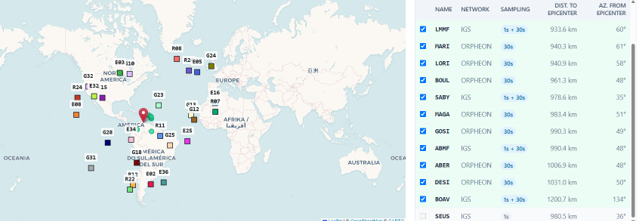 Figure 1. GNSS network geometry and satellites around the epicentral area.
TEC Signals
The figure below shows an example of the detrended TEC time series, where the co-seismic ionospheric disturbance stands out clearly above the background.
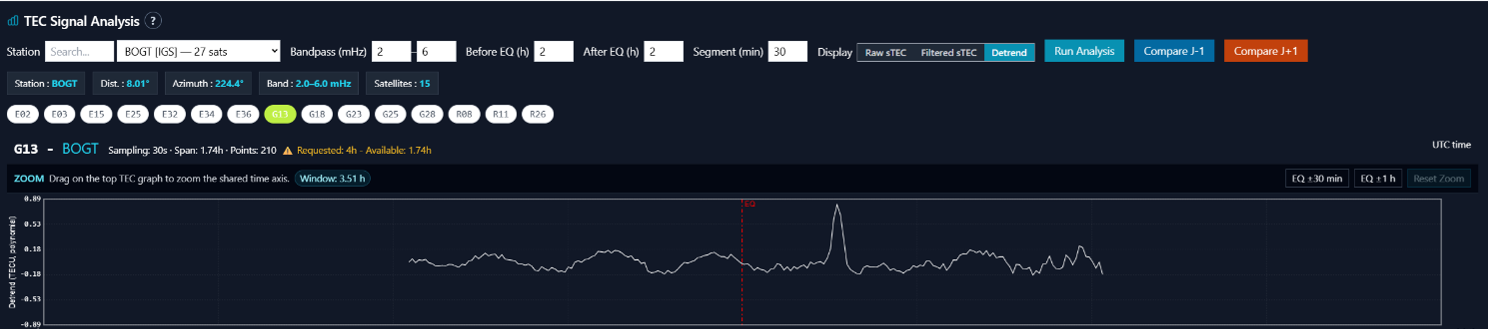 Figure 2. Detrended TEC perturbations following the M7.5 mainshock, showing the characteristic N-shaped acoustic signature.
Why It Matters
Detecting earthquakes in the ionosphere is at the heart of the GO-EUREKA mission. Each well-recorded event like the Venezuela doublet strengthens our ability to characterize source processes from above and supports the development of near-real-time GNSS-based earthquake and tsunami early warning systems.
We will continue to analyze this remarkable doublet — stay tuned for further updates.
Earthquake parameters courtesy of the USGS Earthquake Hazards Program.